
Background
Facebook Infra Data Centers (IDC) is an organization consisting of tens of thousands of employees, and continues to hire thousands more each year. Attempting to keep up with hiring, IDC hiring managers were creating ad-hoc onboarding plans that were inconsistent across geographies, teams, roles. Facebook brought on Slalom to create a tool that would offer a consistent and measurable onboarding process for new hires and hiring managers.
Slalom designed and built a custom onboarding tool for IDC that was launched to a small set of users as an MVP in the first phase of development. I joined this project during its second phase of development.
Goal
The goal of the second phase of development was to expand adoption of the tool to the larger Infra org, bringing the value of the existing tool to a much larger audience.
This meant new features to support scale, additional orgs, and new business requirements. Successful tool adoption would be measured by decreased “time to belonging” for new hires (how long it takes for them to feel like they belong to their orgs), determined through survey results.
Role
I was a Design Co-lead on this project. My responsibilities included:
- Defining features and design direction
- Low-fidelity wireframes
- High-fidelity mockups
- Prototyping
- Gathering feedback from stakeholders
- Delivering for development
- Design QA in development
Team
The Slalom development team consisted of:
- Product manager
- Visual designer
- 6 developers
Our client counterparts on the Facebook team included:
- Program manager
- Design lead
- Development lead
- 3 developers
Understanding Needs
Although research had been done on onboarding processes and users by the initial design team for the first release of the tool, our second phase of development incorporated new stakeholders and new business requirements that I wanted to gain alignment on before starting design or development.
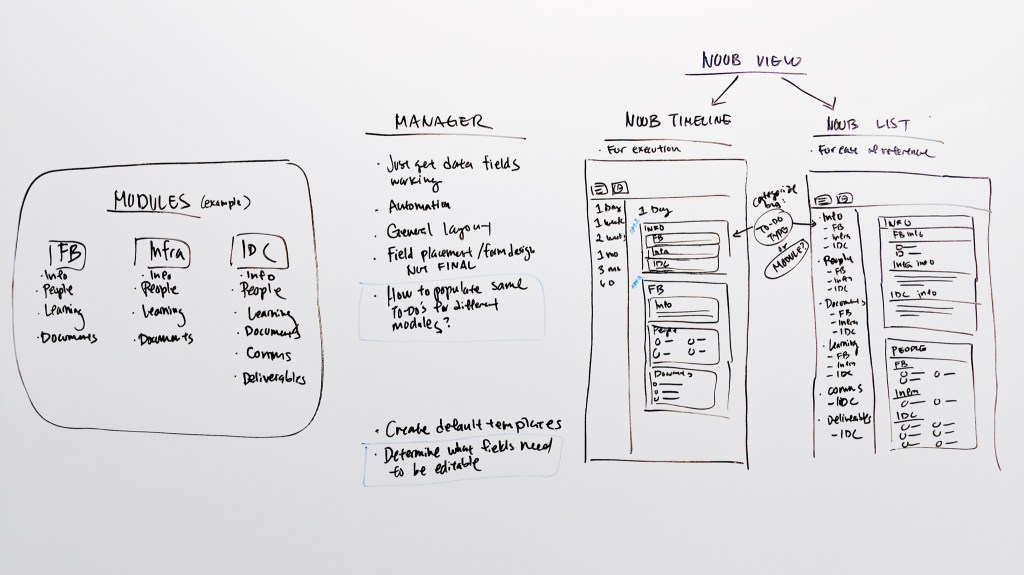
Within the first two weeks of the project, I ran an alignment workshop with the program manager, product design lead, and engineering lead from the Facebook team and the product manager, lead developer, and designers on the Slalom team to help clarify questions from both sides such as:
Who do we consider to be our core users?
Persona goals, pain points, and needs
How many of those users do we anticipate?
What is our understanding of their current processes for onboarding?
What features do we anticipate these users needing?
Who can we talk to from each user group to answer more questions?
Our Facebook program manager facilitated communication with many stakeholders from different orgs to understand their needs and requests. As designers, we communicated with the program manager to continue clarifying features. We also showed designs to stakeholders during weekly meetings to gather feedback in person.
Creating an informative and actionable Hiring Manager dashboard
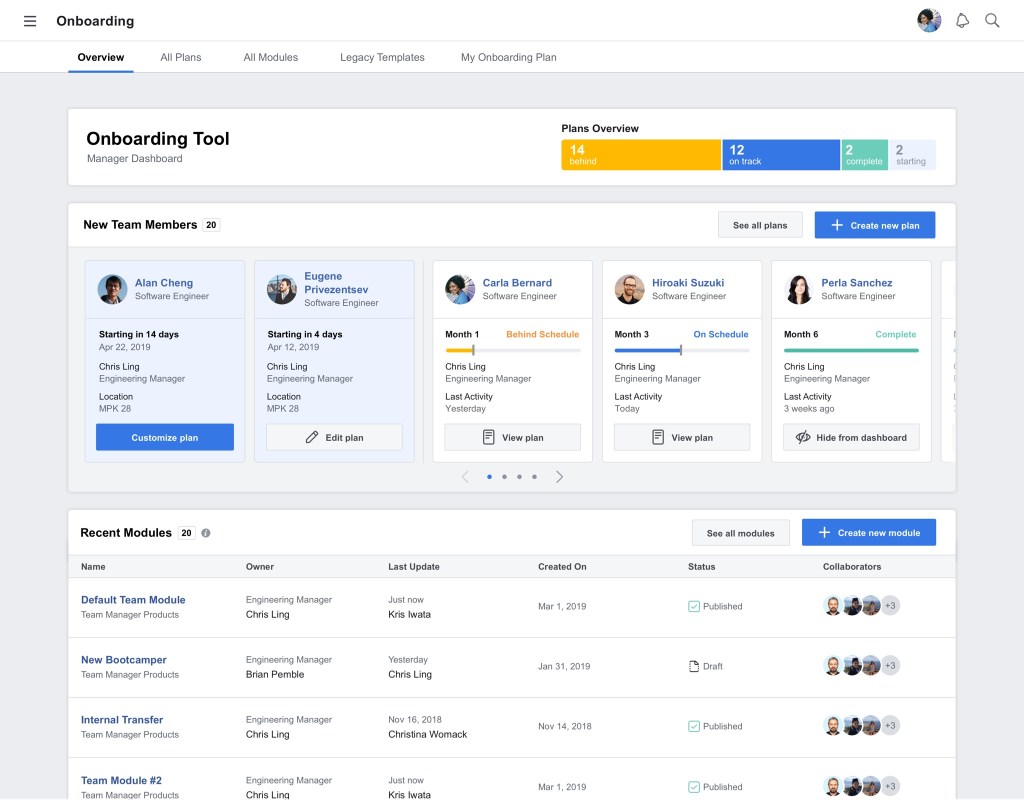
The previous dashboard design was minimal (understandable, as it was an MVP solution), and mostly focused on the ability to search across plans and create a new plan. This updated dashboard has more visual hierarchy utilizing the Facebook People Products pattern library, and supports more advanced functionality, reporting, and actions:
- Integrated with the HR database to show a prioritized list of incoming hires (hires that have yet to be onboarded).
- Highlights progress of hires who have been assigned an onboarding plan.
- Improved sorting, filtering and plan creation capabilities.
Giving New Hires a clearer sense of timeline and tasks
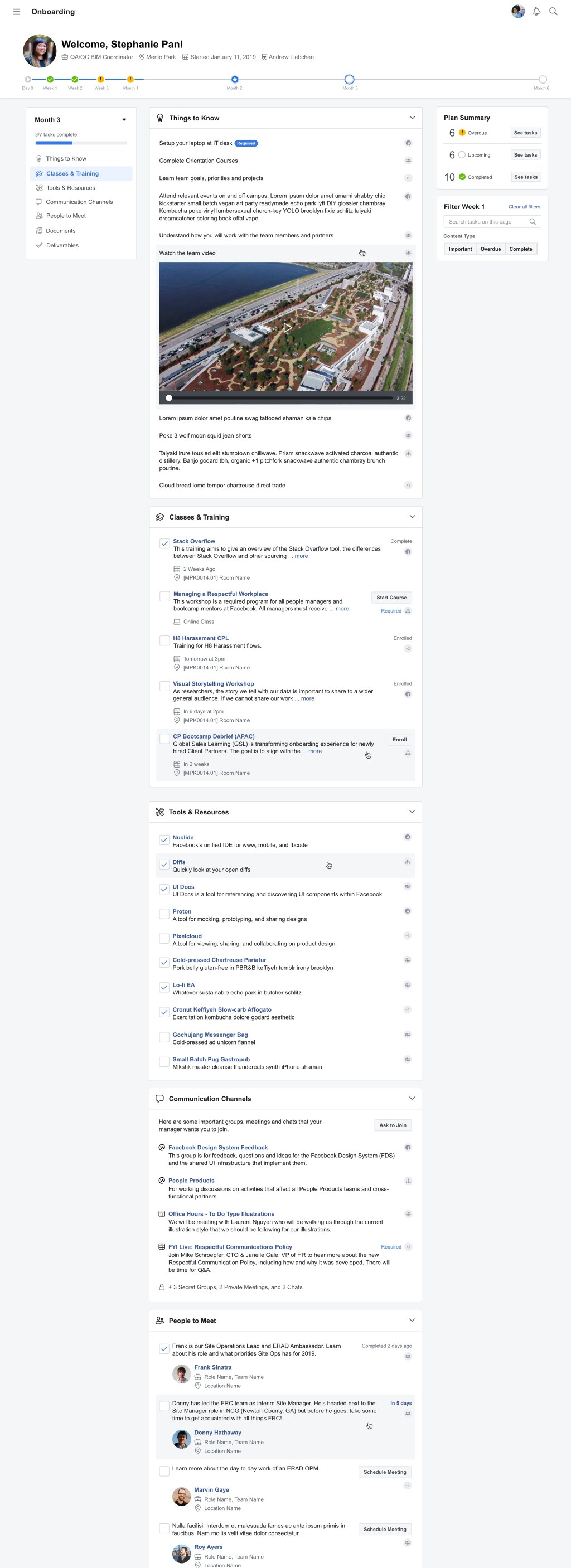
The previous new hire onboarding plan was a simple checklist of items, and did not support the new information architecture now required with multiple orgs and additional categories for tasks. We added functionality so that new hires could find more value from their onboarding plans:
- Understand their progress throughout onboarding with a visual timeline, progress bars, statistics.
- Quickly find and address tasks that are required and overdue.
- Search and filter through tasks to find them easily.
- View all onboarding tasks and resources in a list view for reference later on.
Standardizing plan creation across business units
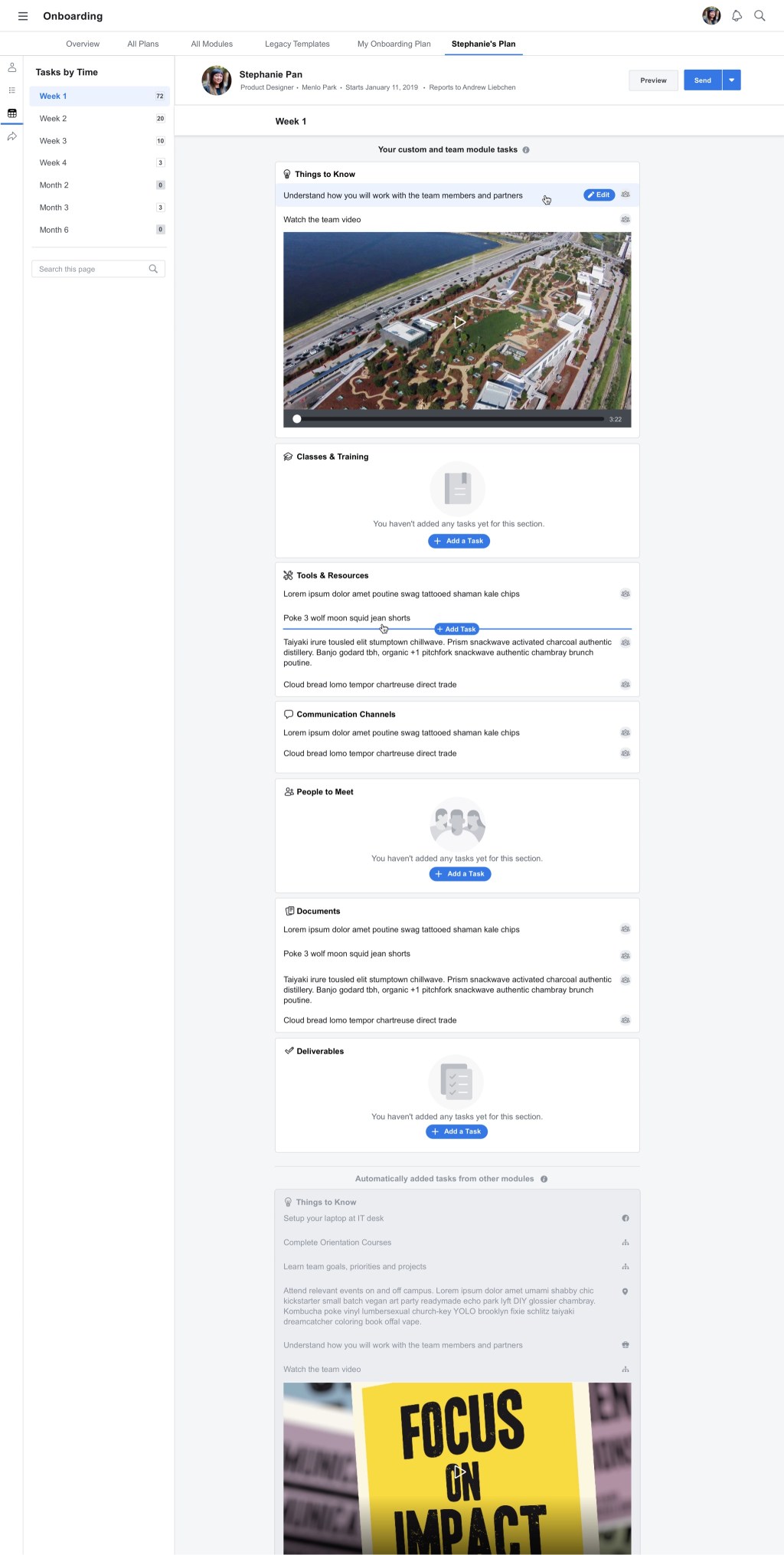
We fundamentally restructured the information architecture for how plans are created. Instead of focusing on just one org (IDC) in the MVP, we now needed to accommodate content from every org that the new hire is a part of, and pull that content into the overall plan automatically based on the new hire’s data. We also made editing a plan much easier for Hiring Managers.
- A more organized left-hand navigation system that allows quick access to the things that matter to hiring managers.
- Quickly add new content to a plan through simple inline editing.
- Sort onboarding plans by task types or timeframe.
Launch, feedback, and the future
Feedback was very positive after launch, gathered through an active Facebook group for the onboarding tool that users frequented. This wasn’t surprising, as we had presented designs and gathered feedback frequently from key stakeholders by showing design prototypes and coded features throughout development.
Requests for more features rolled in, and there was still more to do on the roadmap (analytics, surveying users) as the Facebook product team took this tool in-house and continued development by growing their own team around it.
 STEPHANIE PAN